
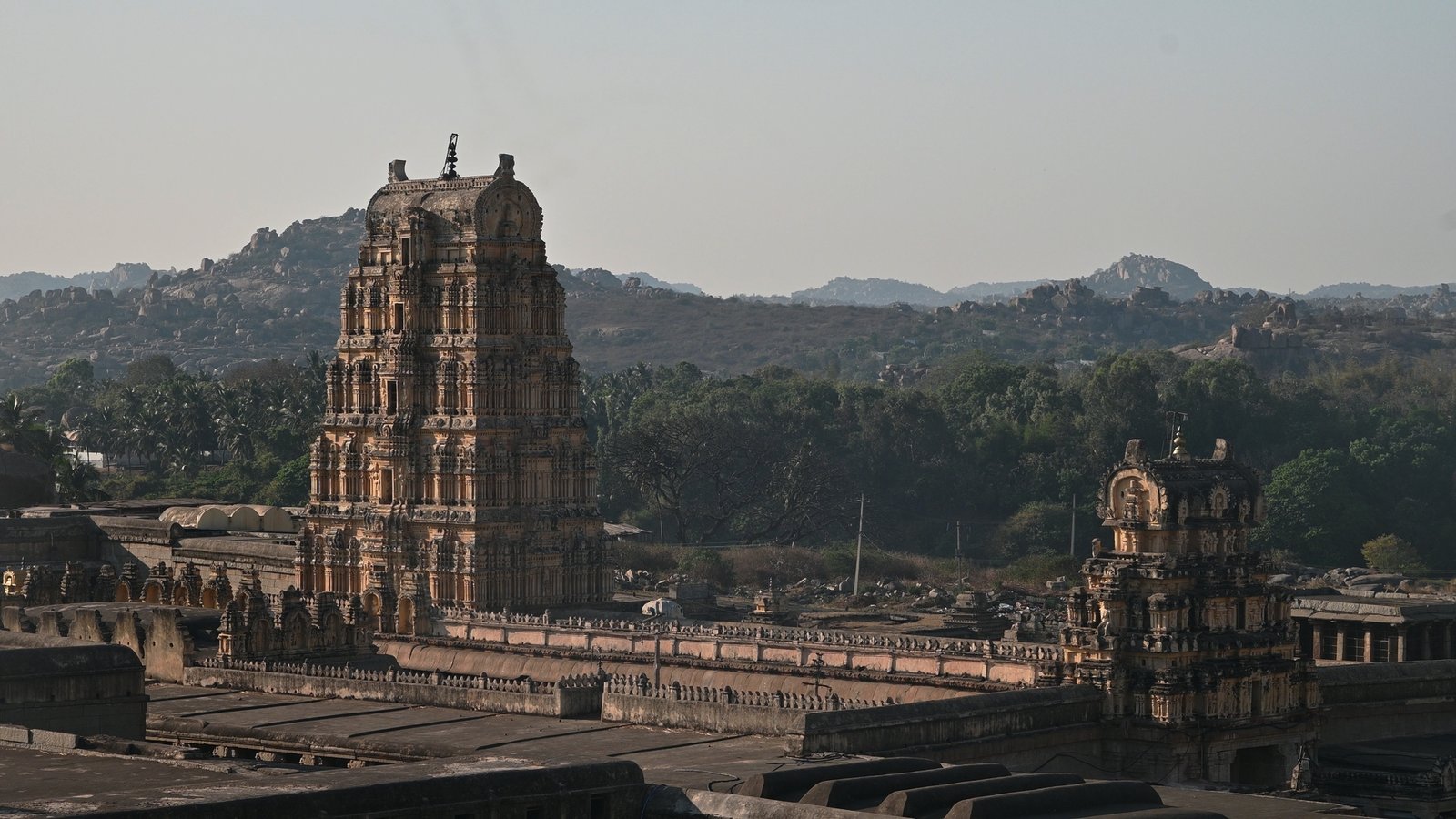
Travelling around Hampi feels like stepping into a forgotten world, where time slows and history breathes through every stone. As the sun casts its golden light over scattered ruins and towering boulders, you find yourself wandering through the echoes of a once-great empire, where ancient temples, quiet riverbanks, and hidden pathways invite you to explore at your own pace.
There are some places in the world that you visit, enjoy, and then quietly move on from. You collect a few photos, a handful of memories, and eventually they blur into the long list of places you’ve been. And then there are places like Hampi. Places that stay with you long after you’ve left. Places that shift something inside you without asking permission.
For us, Hampi was exactly that kind of place.
Travelling Around Hampi: The Temples
As Western travellers, we genuinely thought we had already seen grandeur. We’ve wandered through castles in Europe, stood among ancient ruins scattered across continents, and admired monuments that have shaped entire civilisations. But nothing quite prepared us for the sheer scale, history, and atmosphere of Hampi. This UNESCO World Heritage Site isn’t just a collection of neatly arranged ruins; it feels like stepping into another world entirely, one that still breathes beneath the surface.
From the very beginning, everything about Hampi felt special. Even arriving there carries a sense of anticipation. One of the first things I noticed was the approach to the temple complexes, long, open roads stretching ahead, framed by dramatic boulder‑strewn landscapes and palms swaying gently in the heat. There’s something about that slow reveal that builds tension in the best possible way. The closer you get, the more the grandeur begins to assert itself. And then suddenly, you’re standing in front of these colossal stone structures, craning your neck upward, wondering how on earth something so intricate and immense could have been built centuries ago without modern tools, machinery, or technology.
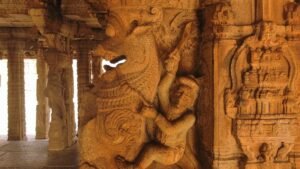
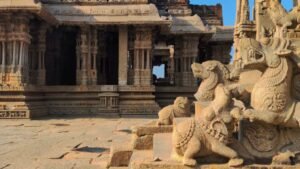
The carvings were what truly stopped us in our tracks. Every surface seemed alive with stories. Gods, animals, dancers, warriors all etched into stone with astonishing precision. Some carvings were bold and commanding, others delicate and intimate. You find yourself leaning in closer, running your fingers just above the surface, tracing lines that were carved by human hands hundreds of years ago. It’s impossible not to feel a sense of awe. Honestly, “mind‑blowing” doesn’t quite cover it.
As we explored further, that sense of stepping back in time only deepened. Standing among these temples, bazaars, and ruins, you can almost imagine what life must have been like when Hampi was the heart of one of the most powerful empires in Indian history, the Vijayanagara Empire. At its peak between the 14th and 16th centuries, this wasn’t just a religious centre. It was a thriving, wealthy capital city, bustling with activity, innovation, and cultural exchange.
Travelling Around Hampi: The Vijayanagara Empire
What fascinated us most was learning that Hampi wasn’t isolated at all. In fact, it was deeply connected to the wider world. The Vijayanagara Empire traded with regions as far as Persia, Portugal, and other parts of Europe. Spices, textiles, precious stones, and horses moved through these very streets. Walking through the ruins, knowing that merchants, travellers, and diplomats from across the globe once passed through these spaces, made the whole experience feel even more surreal. It suddenly didn’t feel like “old history” it felt alive, layered, and global.
We also learned that parts of the site are being carefully restored by the Indian government and archaeological teams, which was reassuring to see. You can spot areas where preservation work is underway, and it’s clear that a great deal of thought has gone into maintaining authenticity while protecting the structures from further decay. It’s a delicate balance, preserving the past while allowing the present to engage with it, and Hampi feels like a place where that balance truly matters.
Travelling Around Hampi: Where to Stay
Travelling around Hampi, we were lucky enough to find an absolute gem of a place to stay, Mahesh Guest House. From the moment we arrived, Mahesh and his family welcomed us not as tourists passing through, but as if we were long‑lost friends returning home. There’s something incredibly grounding about that kind of hospitality. It instantly shifts the way you experience a place. You don’t just observe, you belong, even if only for a short while.

At first, we did what most travellers do. We followed the crowds to the obvious restaurants and tourist‑friendly spots. But it didn’t take long before curiosity got the better of us. We noticed where the locals were eating tucked‑away eateries just off the main paths, small places with no menus in English and no attempt to attract passing tourists. Quietly slipping away from the main routes turned out to be one of the best decisions we made.
Not only did we save a surprising amount of money, but we gained something far more valuable: connection. We sat with locals, shared meals, and listened to their stories. Many had grown up in Hampi, their families rooted there for generations. Hearing about their lives, their relationship with the land, and what it’s like to grow up surrounded by history added a whole new layer to our experience. It was captivating for both Gary and me.
One thing that really stood out during our time there was how seamlessly animals are woven into daily life. Cows wander freely through the streets, completely unbothered by traffic, tourists, or time itself. In India, cows are considered sacred in Hindu culture, symbolising life, nourishment, and motherhood. They’re protected and respected, which is why you’ll often see them calmly strolling through towns as if they own the place, which, to be fair, they kind of do.
Then there were the dogs and cats, mostly feral, often dusty, but undeniably adorable. I’ll admit, I fell in love with about ten of them and briefly considered opening a dog sanctuary on the spot. Gary, however, was the voice of reason, constantly reminding me not to stroke them and, unfortunately, that we couldn’t just pop one into our suitcase and take it home. (Apparently, that’s “not how international travel works.” Who knew?)
Another moment that stayed with us was how often locals would approach us and ask for selfies. It was such a lovely and unexpected part of the experience. There’s a genuine curiosity and warmth towards Western travellers, and even when there was a language barrier, it didn’t matter in the slightest. Smiles, laughter, and a quick photo said everything that needed to be said. The people we met were kind, welcoming, and full of life, which made us feel completely at ease.
Travelling Around Hampi: Getting Around Hampi
Travelling around Hampi is very much part of the adventure. If you’re staying in one of the guesthouses like we were, you’ll likely need a rickshaw to get you to the first temple sites. From there, you can explore quite a lot on foot, but many travellers choose to hire a rickshaw for the day to cover more ground.
Our biggest lesson? Always negotiate the price. It’s expected, it’s part of the culture, and you’ll almost always get a better deal if you do all with a smile and mutual respect.
Many of the temples are free to enter, which feels astonishing considering their scale and historical importance. A few of the more prominent sites do charge an entry fee, with the main ticketed area costing around 500 INR for foreign visitors, roughly £5, €6, or $7. Honestly, it’s worth every penny.
Beyond the temples, Hampi is alive with nature and everyday life. We saw wild monkeys darting across ruins, birds soaring overhead, and tiny squirrel‑like creatures making the cutest squeaking sounds, a constant, cheerful soundtrack to our days. Fishermen from nearby villages cast their nets from small boats, goat herders guided their flocks along dusty paths, and life unfolded at an unhurried pace that felt both calming and deeply human.
Travelling Around Hampi: Holi
One of the most unforgettable parts of our trip was experiencing Holi with the local village.
Back home in the UK, Holi is often simplified into “the festival of colour”, people throwing powder paint and having fun. But being there revealed something much deeper.
The night before Holi is marked by a ritual often referred to as the “burning” ceremony. It symbolises the victory of good over evil and the burning away of negativity, past burdens, and anything that no longer serves you. Standing there, watching flames rise into the night sky, it felt deeply meaningful like a collective reset shared by an entire community.
And then came the next day.
- Colour.
- Laughter.
- Music.
- Pure, unfiltered joy.
Everyone, locals and tourists alike, came together in celebration. There were no barriers, no divisions, just people sharing happiness in its simplest form. We were covered head-to-toe in vibrant powders, laughing with people we had only just met. It was chaotic, beautiful, and completely unforgettable.
Every day in Hampi brought something new. We wandered through ruins, across boulder‑strewn landscapes, and along quiet village paths. Along the way, we captured some incredible footage for our YouTube documentary, trying our best to do justice to a place that feels almost impossible to fully capture on camera.
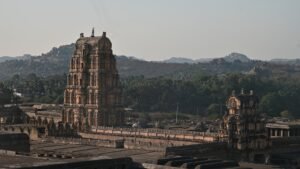
Travelling around Hampi feels like stepping into a forgotten world, where time slows and history breathes through every stone. As the sun rises and spills golden light across the landscape, the surreal beauty of towering boulders and ancient ruins begins to unfold, inviting you into the heart of a once magnificent empire. You wander past intricately carved temples, along quiet riverbanks, and through dusty paths that seem to carry whispers of centuries gone by.
There’s a rhythm to the place, unhurried, almost sacred that encourages you to pause, to take it all in, and to lose yourself in the stillness. Each corner reveals something unexpected, from hidden shrines to sweeping viewpoints, making every moment feel like a discovery. It’s not just about what you see, but how you feel immersed in history, surrounded by beauty, and gently removed from the rush of the modern world. And as the day fades into a soft, glowing sunset over the ruins, you realise that the true experience lies in the journey itself, travelling around Hampi, and simply being present while travelling around Hampi.
Want to read further on why we picked India? Go to: https://earthexplorerpro.com/why-travelling-around-india-is-the-best-idea/